
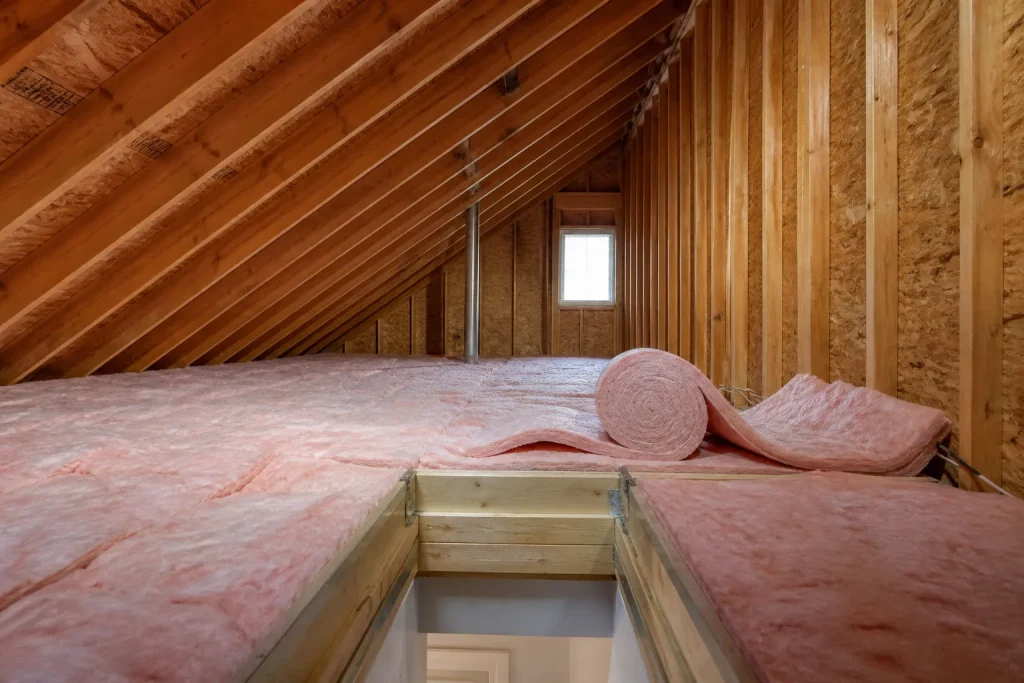
Johns Manville Attic Insulation in Summerlin: A Homeowner’s Guide
Attic temperatures in Summerlin routinely climb past 160°F in July. That heat doesn’t just make the attic unpleasant to stand in; it exposes every compressed batt, every unsealed gap, and every lazy staple job that looked fine on a cool October morning. Johns Manville makes genuinely good insulation. But the name on the bag means almost nothing if the installation is sloppy, and in Summerlin’s heat, sloppy installation costs you money every single month. This guide covers what JM insulation actually can and can’t do in a Nevada desert home.
If you’d rather skip the homework and get a straight answer from someone who’s been in these attics for decades, call (866) 450-1718. Free estimates, and a live person always picks up.
What Johns Manville products actually work in Summerlin’s heat?
Johns Manville’s residential lineup covers two main paths for a Summerlin attic: fiberglass batts and blown-in fiberglass. Their Climate Pro line is the batt product most homeowners encounter, and it’s a solid, formaldehyde-free fiberglass batt with a rated R-value per inch that holds up when it’s installed correctly. Spider is JM’s blown-in fiberglass, sprayed in loose and fluffed to fill the odd shapes and tight corners that batts can’t reach.
Here’s the part most product spec sheets skip. Most JM performance data is written for moderate climates where attic temps peak around 120°F. Summerlin attics sit above 150°F for weeks at a stretch, sometimes longer. At those temperatures, fiberglass itself doesn’t melt or degrade, but the performance of the whole assembly depends on things the bag can’t tell you:
- Density matters more in heat. Blown-in fiberglass that’s under-fluffed loses effective R-value fast. Spider needs to hit the right settled density, not just the right depth on a ruler.
- Compression is permanent damage. A batt that’s crammed around a duct or squashed under a plywood walkway is effectively a thinner R-value for the life of the install. In Summerlin, that compressed strip becomes a hot spot you feel in the upstairs bedrooms.
- Air movement defeats R-value. Fiberglass insulates by trapping air. If hot attic air moves through it because the attic isn’t sealed, the rated R-value you paid for isn’t the R-value you’re getting.
None of that is JM’s fault. All of it is the installer’s responsibility. We’ve pulled batts out of attics in The Ridges and Red Rock Country Club where the brand was right and the install was wrong, and the homeowner was paying the price in their monthly bill.
Why R-value alone is misleading in a Summerlin attic
R-value measures resistance to conductive heat flow. It does not measure how well your attic handles radiant heat, and radiant heat is the dominant load in Summerlin. Every summer, the underside of your roof deck radiates heat downward into the attic, and the insulation is expected to block that transfer.
Fiberglass handles conduction well. It does a much weaker job with radiation, and that’s why emissivity and air sealing matter as much as the R-number printed on the JM packaging. Three things work together in a Summerlin home:
- Air sealing stops hot attic air from leaking into the living space through gaps around can lights, top plates, plumbing penetrations and attic hatches. No insulation product, JM included, stops air movement.
- Insulation R-value slows the conductive heat that’s already made it past the ceiling plane.
- Radiant barrier reflects a large share of the radiant heat before it reaches the insulation in the first place.
A homeowner who upgrades from R-19 to R-49 with JM material but skips air sealing will see some improvement. A homeowner who air-seals first and then adds the same JM product to the same R-value will see more. That’s not a knock on JM. That’s how attic heat works in a desert climate, and it’s the order of operations we walk through on every Summerlin energy audit. If you’re weighing options, our attic insulation in Summerlin page breaks down the material choices side by side.
What does JM’s warranty actually require (and what cheap installers skip)?
Johns Manville’s product warranties cover manufacturing defects, not installation errors, and the installation has to meet the product’s published requirements for coverage to hold. In practice, that means a few details matter, and they’re the ones a low-bid crew tends to rush:
- Proper venting clearance. Insulation must not block soffit vents or baffles. Batts shoved into the eave without baffles cut airflow and cause moisture problems in Summerlin’s cool months.
- Correct depth and density. JM publishes target settled thickness for blown-in and target installed thickness for batts. A crew that eyeballs it is guessing with your money.
- No compression. Batts should be cut to fit, not crushed around obstructions. If you find compressed batts after a job, the install was wrong regardless of what the bag said.
- Vapor and air control as specified. In our climate the priority is air sealing at the ceiling plane, not a vapor barrier in the attic, but the assembly still has to match the manufacturer’s guidance.
- Documentation. Photos of depth readings and sealed penetrations. A reputable installer takes them without being asked.
How do you verify? After the job, ask for photos and a settled-depth reading. Walk the attic with a flashlight and look for cuts around pipes, sealed top plates, and uniform coverage. If the crew can’t show you any of that, that’s your answer.
Batt or blown-in for a Summerlin ranch with limited attic clearance?
Older ranch-style homes around Sun City Summerlin and parts of The Lakes often have tight attics with low sloped ceilings, HVAC ducts everywhere, and limited headroom. In those attics, blown-in JM Spider usually wins for a simple reason: it flows into the spaces batts can’t reach without being forced or cut.
Here’s the practical comparison for a Summerlin ranch:
- JM batts are predictable and quick where the attic is open and rectangular. They struggle around ducts, cross-bracing and the low kneewall edges of a ranch roofline.
- JM Spider blown-in fills odd shapes and gaps cleanly, and it can be installed at the correct density for hot climates. It’s the better fit for older Summerlin ranches with complex framing and limited clearance.
- Hybrid installs are common: blown-in over the field, batts in tight closets or over access hatches. That’s fine as long as the transition is air-sealed, which is where installs often fall apart.
If your attic also has moisture signs, we’d look at crawl space work before adding insulation on top of a problem. That’s covered on our crawl space encapsulation and vapor barrier in Summerlin page. And for hot-roof applications, the spray foam insulation in Summerlin option is worth considering, since closed-cell foam from Icynene or Demilec solves air sealing and insulation in one pass.
What to ask any installer before they touch a roll of JM material
We’ve been called out to fix enough half-finished attic jobs that we’ve learned what separates a real installer from a fast one. Ask these questions before you sign:
- “Will you air-seal before insulating?” If the answer is “not necessary” or “we’ll see,” walk. Air sealing is the step that makes the JM product work in a Summerlin attic.
- “What settled depth and density will you install to?” They should be able to name the number, not just the R-value target.
- “Are you licensed and insured? Can I see the license number?” It’s on the contract or it isn’t. A published license number is a real, checkable fact.
- “Will you take photos before and after?” Every install we do gets photographed so the homeowner can verify what was covered.
- “What’s covered if something goes wrong?” A workmanship guarantee is the difference between a warranty claim and a headache. Ours is the Done Right Promise: if it’s not done right, we make it right.
- “Can I get a second opinion on this written estimate?” You should always be able to. We offer that free, no trip charge inside our service county.
If you’d rather hand it off to a crew you can verify, call (866) 450-1718. Our background-checked, uniformed technicians install Johns Manville alongside CertainTeed and GreenFiber materials, and we put everything in writing up front.
The Bottom Line
Johns Manville is a solid brand, and in a Summerlin attic it’s a good choice, provided three things happen around it: the attic gets air-sealed first, the install hits the correct settled depth and density, and the paperwork backs up the work. Skip any of those three and the JM brand can’t save you. In a 160°F attic, installation quality is the whole ballgame.
The team at Walt’s Insulation Summerlin has installed insulation across Las Vegas neighborhoods since 2000, with technicians carrying up to 26 years of experience. Our work is covered by the Done Right Promise, calls are answered by a live person 24/7, and we offer a permanent 10% discount for seniors and veterans along with $40 off any repair over $200. Start with a free estimate by calling (866) 450-1718.
Frequently Asked Questions
Yes. Johns Manville’s Climate Pro batts and Spider blown-in fiberglass are both appropriate for Summerlin attics when installed to the manufacturer’s specified depth and density, with air sealing done first. Fiberglass itself handles the heat fine; the risk is a poor install, not the product.
Blown-in installs for a typical Summerlin ranch run in the same range as comparable fiberglass products, driven mostly by attic square footage, the R-value target, and any air sealing or baffle work included. Get a written estimate that itemizes depth, density and air sealing. Call (866) 450-1718 for an exact quote, estimates are free.
For most Summerlin homes with rooflines that leave low clearance around ducts and framing, blown-in Spider fills better and holds density more reliably. Batts are fine for open, rectangular sections, but they compress badly around obstructions. An honest installer will tell you which fits your attic.
Often, yes. We answer the phone live 24/7 and schedule same-day assessments when the calendar allows. We give you a free estimate, and if you already have a written estimate from someone else, we’ll give you a free second opinion on it. Call (866) 450-1718.
For everything else we do in the neighborhood, start at Walt’s Insulation Summerlin home.
Written by the team at Walt’s Insulation Summerlin.
Need Insulation Help?
Call Walt's Insulation Summerlin - licensed & insured, here with fast after-hours help in Summerlin.
(866) 450-1718